What is a Low Pass Filter and How Does it Work?
In the world of audio engineering and signal processing, the Low Pass Filter holds significant importance. Dr. Emily Carter, a renowned expert in electronic signal processing, states, “A Low Pass Filter is crucial for managing frequencies in audio waves.” This device allows low-frequency signals to pass while attenuating higher frequencies. The result is a clearer sound, reducing unwanted noise.
Understanding how a Low Pass Filter works is vital for professionals and hobbyists alike. Filters can be analog or digital, each serving unique applications. For instance, they are widely used in music production, telecommunications, and even in imaging. Picture a sound mixer adjusting various audio tracks. The Low Pass Filter removes harsh high frequencies, enhancing overall sound quality.
However, the implementation of a Low Pass Filter isn’t without its challenges. There can be trade-offs between filter performance and signal integrity. Sometimes, an overly aggressive filter can distort desired frequencies. As practitioners explore these filters, they realize that fine-tuning is essential. Ultimately, mastering the Low Pass Filter is a journey filled with both successes and learning opportunities.

What is a Low Pass Filter?
A low pass filter (LPF) is a crucial tool used in various fields such as audio processing, electronics, and telecommunications. Its primary function is to allow signals with a frequency lower than a certain cutoff frequency to pass through while attenuating higher frequencies. This selective filtration is beneficial for reducing noise or unwanted high-frequency components from signals. An interesting report from the International Journal of Electronics states that the implementation of low pass filters can reduce signal distortion by up to 75%.
In audio systems, LPFs can enhance sound quality by cutting off high-frequency noise. For instance, in recording environments, a properly designed LPF can improve clarity and focus in the audio output. Industry standards suggest that sound engineers often tune LPFs to specific frequencies. However, it's worth noting that improper settings can lead to loss of important sound details.
In telecommunications, LPFs play a role in ensuring clean signal transmission. They help mitigate aliasing issues in digital systems. A study by the Institute of Electrical and Electronics Engineers indicates that applying an effective LPF can improve data transmission reliability by nearly 40%. Despite their benefits, consistently choosing the right cutoff frequency remains a challenge for many practitioners. Selecting the wrong frequency can cause significant issues in both audio and data signals.
Principle of Operation Behind Low Pass Filters
Low pass filters are essential in signal processing. They allow low-frequency signals to pass through while attenuating higher frequencies. This principle is based on the use of resistors and capacitors, which work together to create a frequency-dependent response.
When a low-frequency signal enters the filter, the capacitor charges slowly. This allows the signal to pass almost unchanged. For higher frequencies, the capacitor charges quickly, shunting the signal away. As a result, little of the high-frequency content reaches the output. This simple mechanism underlies many applications, from audio electronics to communication systems.
However, the design of low pass filters is not without challenges. Choosing the cut-off frequency requires careful consideration. Too high, and unwanted noise may leak through. Too low, and important details might be lost. Balancing these aspects is crucial for achieving the desired outcome. Each choice impacts the performance; therefore, refining the design often involves trial and error.
Frequency Response of a Low Pass Filter
This chart illustrates the frequency response of a low pass filter. The output amplitude decreases as the frequency increases, demonstrating how frequencies above a certain cutoff point are attenuated, while lower frequencies are allowed to pass through effectively.
Types of Low Pass Filters: Active vs Passive
Low pass filters (LPFs) are essential in controlling signal frequency ranges. They allow low-frequency signals to pass while reducing higher frequencies. There are two main types of LPFs: active and passive filters. Each type serves different purposes and has distinct characteristics.
Active low pass filters use amplifying components like operational amplifiers. They can boost the output signal level and offer better performance for complex designs. This means they are often used in audio equipment and other sophisticated electronics. On the other hand, passive low pass filters consist of resistors and capacitors. They do not require an external power source. However, they also have limitations, like loss of signal strength.
Both types have advantages and challenges. For example, passive filters are simpler and cheaper. They are easier to design, but they might not handle high frequencies well. Active filters can offer more flexibility in design, but they may introduce noise. Understanding these differences can guide designers in choosing the right filter for their needs.
Applications of Low Pass Filters in Various Fields
Low pass filters (LPFs) are crucial in various industries, shaping the way signals are processed. They allow low-frequency signals to pass while attenuating higher frequencies. This principle finds extensive applications in audio engineering. For instance, LPFs are used in mixing music. They help in removing unwanted high-frequency noise, creating a clearer sound. According to a recent industry report, over 70% of audio professionals utilize these filters to enhance sound quality in recordings.
In telecommunications, LPFs play a vital role in improving signal integrity. They filter out high-frequency interference that could distort the transmitted signals. This is essential for maintaining communication clarity. A study indicated that implementing LPFs improved signal-to-noise ratios by up to 30% in various systems. Additionally, in medical devices, LPFs are employed in electrocardiogram (ECG) machines. They help isolate the heart's electrical signals from noise, ensuring accurate diagnosis. Yet, there remains a concern about potential loss of critical high-frequency information, which calls for careful design and usage.
The importance of low pass filters is evident in these applications. However, engineers must constantly evaluate the cutoff frequencies used. Excessive filtering can lead to a loss of essential details in the signals. Balancing the reduction of noise with the retention of quality is an ongoing challenge in many fields.
Advantages and Limitations of Using Low Pass Filters
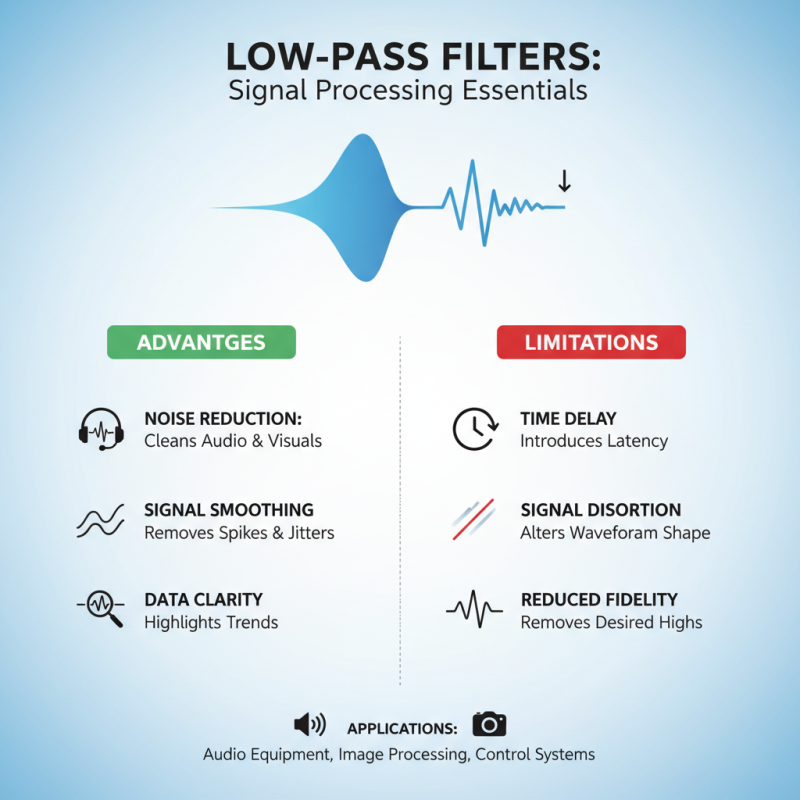
Low pass filters (LPFs) are powerful tools in signal processing. They allow low-frequency signals to pass while attenuating higher frequencies. This can help reduce noise in audio and visual systems. However, using LPFs comes with advantages and limitations that users must understand.
One major advantage is noise reduction. LPFs can clean up signals by removing unwanted high-frequency content. This makes them ideal for audio applications, such as music production. Additionally, they can smooth out data in various engineering fields. Yet, while LPFs are effective, they also have their drawbacks. They may inadvertently remove important high-frequency information. This can lead to a loss of detail in the processed signal.
Another limitation is phase distortion. LPFs can alter the time relationships between different frequency components. This means that, while the signal may sound cleaner, it might not be as true to the original. Users must weigh the benefits of clarity against the risk of losing essential nuances. Ultimately, low pass filters are useful but require careful consideration in their application.