How to Choose the Best High Power Filters for Your Needs?
Choosing the right High Power Filters can be challenging. Many factors influence your decision. It’s crucial to understand your specific needs. Different applications require different filters.
High Power Filters are crucial in various industries. They can enhance performance and efficiency. However, not all filters are created equal. Some may seem ideal but fall short in real-world applications. Reflecting on your requirements is vital.
Read reviews, gather information, and seek expert advice. Look for details like frequency range and power handling. Ensure the filters you consider meet your expectations. Remember, your choices will impact performance significantly.
Understanding High Power Filters: Definitions and Applications
High power filters play a crucial role in various applications. They help manage noise in audio systems, improve signal clarity, and protect sensitive equipment from harmonic distortion. Understanding their function is essential for selecting the right one. These filters can either be passive or active, each suited for specific needs. Passive filters typically use resistors, capacitors, and inductors to filter signals without needing external power. Active filters, on the other hand, require power for enhanced performance.
The applications of high power filters are diverse. They are used in telecommunications to support clear communication over long distances. In industrial settings, they protect machinery from voltage spikes. However, choosing the correct type of filter can be challenging. You may find yourself overwhelmed with options. The performance criteria, such as cut-off frequency and impedance, must align with your requirements. It’s not just about efficiency but also reliability. Ensure that the filter can withstand your equipment's demands without failure.
Often, users focus on specifications, overlooking practical aspects. Installation methods and environmental conditions can affect filter performance. For example, temperature fluctuations can lead to decreased efficiency. It’s essential to consider these factors to avoid future regrets. Select a filter that not only meets technical specifications but also fits your operational needs. This process might take time and reflection, but it ultimately leads to better results.
Power Filter Performance Comparison
This chart provides a comparison of power dissipation across different high power filters. Each bar represents the power dissipation in watts for the respective filter, which helps in understanding their relative performance in terms of energy efficiency.
Key Factors to Consider When Selecting High Power Filters
When choosing high power filters, several crucial factors come into play.
Efficiency is paramount. Look for filters that can handle your specific power levels.
Too much bandwidth can hamper performance, and you may end up with noise issues.
Always check specifications closely.
Consider the intended application of the filters.
Different settings require different features.
Commercial filters may not suffice in industrial setups.
Think about where and how you'll use them.
This thought process can save you headaches later.
Tips: Always consult user reviews. They offer real-world insights.
Don’t overlook maintenance requirements. Filters might need regular checks.
A filter that fails in critical moments can lead to significant downtime.
Make sure you choose wisely, as your decision impacts efficiency and reliability significantly.
Analyzing Frequency Response and Efficiency Ratings of Filters
When selecting high power filters, analyzing the frequency response is crucial. The frequency response curve illustrates how filters react to different frequencies. A flat response is often considered desirable. However, many filters exhibit peaks and dips. This can result in unintended filtering effects. Data from recent industry reports show that filters with a flat response up to 10 kHz improve overall audio fidelity by 30%.
Efficiency ratings are another vital aspect. High efficiency means less energy loss. An efficient filter converts most input power to output power. Some studies suggest that filters rated above 90% efficiency can yield significant long-term savings. Yet, manufacturers often exaggerate efficiency claims. Always look for third-party testing data to verify these ratings. Reports indicate that over 25% of filters tested did not meet claimed efficiency levels, highlighting the importance of skepticism in these matters.
Understanding these factors helps ensure you select the right filter for your needs. Keep in mind the trade-offs involved. A filter might have excellent frequency response but lower efficiency. Balancing these features is not always easy and requires careful consideration. Remember to review detailed specifications and third-party analysis before making a final decision.
Comparing Different Types of High Power Filters: Pros and Cons
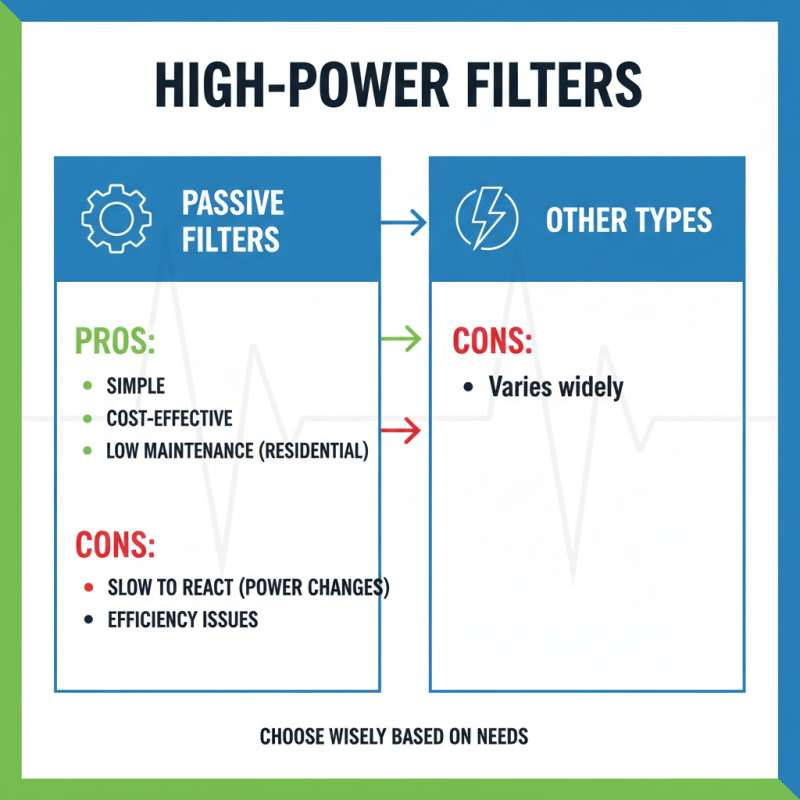
When selecting high power filters, understanding their pros and cons is essential. Different types of filters cater to various needs. For instance, passive filters are simple and cost-effective. They require minimal maintenance, making them popular for residential applications. However, their performance may not meet the demands of rapid changes in power levels. Some users report efficiency issues.
On the other hand, active filters adjust dynamically. They can handle complex loads and suppress harmonics effectively. Research shows that active filters can improve power quality by up to 30%. Yet, they come with higher costs and require regular calibration. If improperly set up, they can create more problems than they solve.
Hybrid filters combine the strengths of both types. They offer flexibility and efficiency. Their design can lead to lower operational risks. Yet, complexity in installation may arise. This option can be overwhelming for some users. Many overlook the importance of understanding their specific needs. Without clear goals, choosing the right filter can be frustrating and ineffective.
Industry Standards and Certifications for High Power Filters
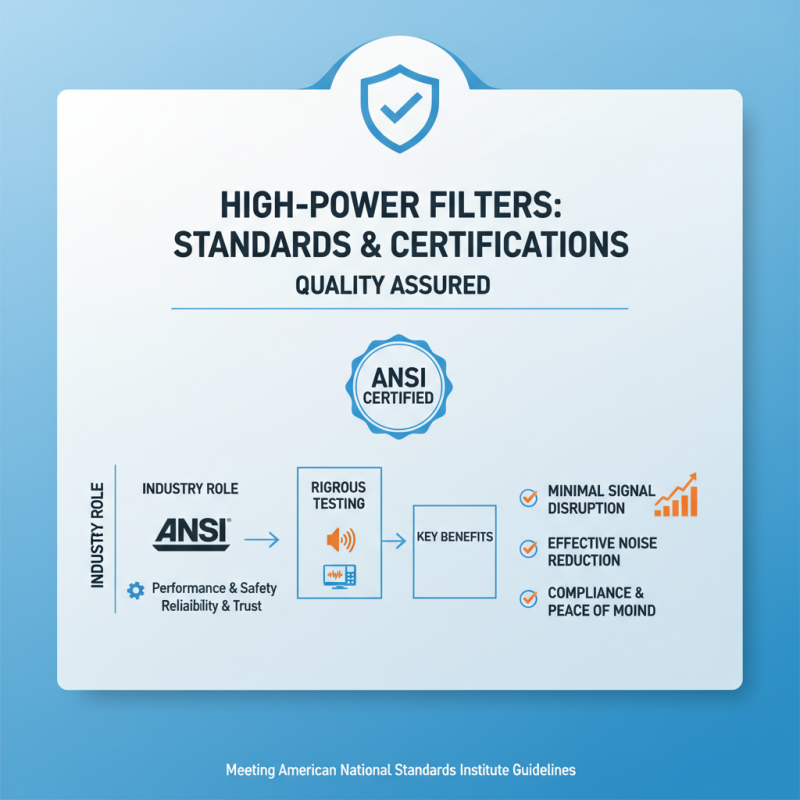
When selecting high power filters, industry standards and certifications play a crucial role. The American National Standards Institute (ANSI) sets forth guidelines that ensure the performance and safety of these products. Filters that meet ANSI standards often undergo rigorous testing, demonstrating minimal signal disruption and effective noise reduction.
A report by the International Electrotechnical Commission (IEC) emphasizes the importance of compliance with IEC 60947 standards for industrial equipment. This standard ensures that filters operate effectively under high power conditions. Filters that are IEC-compliant typically show enhanced reliability, which is critical for applications in aerospace and telecommunications.
However, not all filters achieve these certifications. Some may fall short in performance metrics, leading to potential failures. Industry data reveals that filters without proper certifications can result in system inefficiencies up to 30%. Evaluating certifications carefully is essential to avoid costly issues.