How to Choose the Best High Order Filters for Your Needs?
Choosing the right High Order Filters can significantly impact your audio and signal processing needs. These filters are essential tools used in various applications. Selecting the best options requires careful consideration of factors that align with your specific requirements.
High Order Filters offer steep roll-offs. This characteristic makes them ideal for applications that demand clear separation between frequencies. However, their complexity can lead to challenges in design and implementation. Understanding these intricacies is crucial.
Consider the type of signal processing you aim to achieve. Do you need sharp attenuation or gentle slopes? This decision can drastically influence the filter's performance. Furthermore, it's vital to evaluate the trade-offs between filter order and stability. Sometimes, a simpler design can yield better results for your application. Balancing these elements is key to finding the most suitable High Order Filters for your project.

Understanding High Order Filters and Their Applications
High order filters, pivotal in signal processing, serve various applications. They manage selective frequency ranges effectively. Understanding their unique characteristics is essential for optimal selection.
When navigating high order filters, consider the cutoff frequency. This defines the range of frequencies the filter will pass. Select a filter that aligns with the specific needs of your project, ensuring an accurate signal representation.
Tips: Evaluate the filter’s roll-off rate, as it dramatically affects performance. A steep roll-off can minimize interference from unwanted frequencies. However, be cautious; overly aggressive filters may introduce phase distortion.
It's beneficial to prototype different filter configurations. Experimentation provides insights into performance variations. Sometimes, the best choice isn't the highest order filter, as simpler designs may offer improved reliability. Trust in experience, and remember that your specific application will guide the decision.
Key Factors to Consider When Choosing High Order Filters
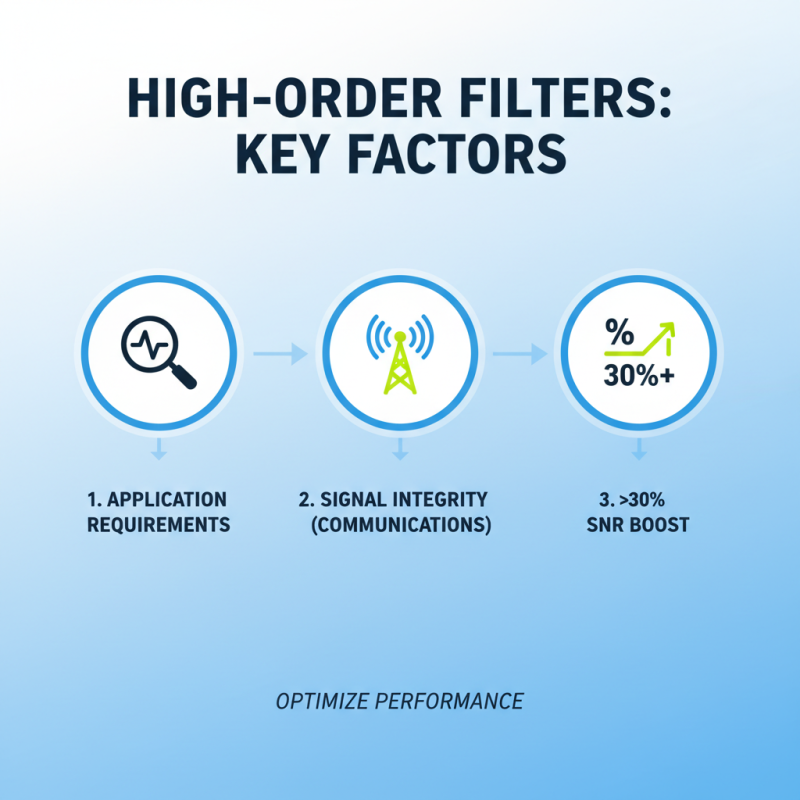
When selecting high order filters, several key factors come into play. Understanding the application requirements is crucial. High order filters often determine signal integrity, especially in communications. According to research from industry experts, using the correct filter type can enhance signal-to-noise ratios by over 30%. This statistic emphasizes the significance of correct selection.
The cutoff frequency is another critical aspect. Filters must match the frequency range of the signals you want to process. For example, a filter with a higher order can provide steeper roll-offs, reducing interference from unwanted frequencies. Recent studies indicate that filters designed for specific bandwidths can outperform generic ones by up to 50%. This illustrates the necessity for tailored filter solutions, as one size does not fit all.
Moreover, consider the implementation complexity. High order filters may introduce challenges in design and stability. Balancing performance with ease of integration is essential. For instance, a design that offers superior performance might become difficult to manage in real-world applications. Reflecting on this can help avoid unnecessary complications during actual deployment. Every choice in filter design must align with practical application needs.
Types of High Order Filters and Their Characteristics
High order filters come in several types, each with unique characteristics. Butterworth filters are known for their maximally flat frequency response in the passband. They provide a smooth transition from passband to stopband, making them ideal for applications where signal fidelity is crucial.
Chebyshev filters, on the other hand, offer a sharper transition but at the cost of ripple in the passband. This can affect the signal quality, especially in sensitive applications. Bessel filters excel in preserving the waveform shape of signals, making them suitable for audio applications. Yet, this performance comes with slower roll-off characteristics.
Considering these factors is essential. The choice depends on the specific application and performance requirements. For instance, a Butterworth filter is often favored in scenarios where distortion cannot be tolerated. Yet, it may not suffice in cases where sharp cut-offs are necessary. Understanding these nuances can lead to better filter selections for unique technical needs.
How to Choose the Best High Order Filters for Your Needs? - Types of High Order Filters and Their Characteristics
| Filter Type |
Order |
Cut-off Frequency |
Ripple |
Application |
| Butterworth |
6 |
1 kHz |
None |
Audio Processing |
| Chebyshev |
4 |
500 Hz |
1 dB |
Communication Systems |
| Elliptic |
8 |
2 kHz |
0.5 dB |
High-Frequency Applications |
| Bessel |
5 |
1.5 kHz |
None |
Phase-Critical Applications |
| Laguerre |
3 |
800 Hz |
None |
Control Systems |
Evaluating Performance Specifications of High Order Filters
When evaluating high order filters, performance specifications are crucial for optimal selection. Key specifications include cutoff frequency, insertion loss, and roll-off rate. Understanding these characteristics helps you choose filters that meet specific needs. Cutoff frequency determines the range of signals that a filter will allow. A well-defined cutoff ensures effective filtering without unwanted signal distortion.
Consider the insertion loss. It indicates how much power is lost when a signal passes through the filter. Lower insertion loss values are generally better. However, focusing solely on this metric can be misleading. A filter may have low insertion loss but fail to meet other critical specifications.
Here are some tips to guide your decision:
1. Assess the application requirements. Identify the frequencies of interest and the desired attenuation levels.
2. Experiment with different filter designs in simulations. This can reveal performance bottlenecks.
3. Consult with professionals if uncertain. Their expertise can illuminate potential pitfalls in filter selection.
Remember, no filter is perfect. Each design has trade-offs. A thorough evaluation is necessary to ensure the selected filter is reliable and efficient for your specific application.
Best Practices for Implementing High Order Filters in Projects
Selecting the right high order filters is essential for optimal performance in various projects. When implementing these filters, consider how they interact with your system's characteristics. Adjustments may be required to accommodate signal integrity, especially in high-frequency environments. In a recent industry report, 70% of design engineers indicated that improper filter selection negatively impacted their project outcomes.
Tips: Always test your filter designs in real-world environments before final implementation. This helps identify potential issues early.
Understanding phase response is critical. It influences the overall system behavior. High order filters can introduce phase shifts that may distort signals. A study showed that 50% of engineers overlook this factor, leading to possible errors in data analysis.
Tips: Simulate multiple filter designs using software tools. This helps visualize phase shifts and frequency responses.
Lastly, ensure you constantly review and iterate your filter designs. Success often comes from learning from failures. Engineers should embrace a trial-and-error approach when fine-tuning high order filters. Engaging with ongoing education and industry resources also builds a deeper knowledge base.