Top 10 Base Station Filters for Optimal Signal Quality and Performance
In the ever-evolving landscape of telecommunications, the importance of high-quality signal transmission cannot be overstated. Base Station Filters play a critical role in ensuring optimal signal quality and performance, acting as gatekeepers that allow desired frequencies to pass while mitigating unwanted noise. As Dr. Emily Carter, a leading expert in RF engineering, aptly stated, “The effectiveness of Base Station Filters directly impacts the overall network performance, making them indispensable in modern communication systems.”
With the growing demand for seamless connectivity and higher data rates, the need for efficient Base Station Filters has become increasingly paramount. These filters are designed to enhance signal integrity and minimize interference, which is essential for maintaining the reliability of mobile networks. As we delve into the top 10 Base Station Filters currently available, we will explore their specifications, functionalities, and the critical factors to consider for achieving superior signal quality.
By understanding the various options in Base Station Filters, network engineers and professionals can make informed choices that align with their performance goals. This article aims to illuminate the key features and advantages of the top contenders in the market, providing valuable insights into optimizing telecommunications infrastructure.

Understanding Base Station Filters: A Comprehensive Overview
Base station filters play a crucial role in maintaining signal quality and performance in wireless communication systems. These filters are designed to selectively allow certain frequency bands to pass while attenuating unwanted signals, thereby reducing interference and ensuring clearer transmissions. Understanding the science behind base station filters is essential for optimizing the overall efficiency of mobile networks. Typically, these filters come in various configurations, including bandpass, low-pass, and high-pass types, each serving specific needs depending on the frequency spectrum involved.
The effectiveness of a base station filter is determined by several factors, including the quality of materials used, the design of the filter, and its installation. Properly designed filters not only improve signal clarity but also increase the capacity of the network by minimizing cross-talk and adjacent channel interference. Additionally, advancements in technology have led to the development of more refined filters, which adapt to changing network conditions and demands. This level of adaptability ensures that communication remains seamless, even in densely populated areas where signal congestion is often a challenge. Understanding these aspects is vital for telecommunications professionals seeking to implement reliable and efficient communication infrastructures.
Top 10 Base Station Filters for Optimal Signal Quality and Performance
Types of Base Station Filters and Their Functions
Base station filters play a crucial role in ensuring optimal signal quality and performance in telecommunications. These filters are designed to eliminate unwanted frequencies while allowing desired signals to pass through, thus enhancing the overall efficiency of communication systems. Various types of filters serve different purposes, primarily categorized into two main groups: bandpass filters and bandstop filters.
Bandpass filters are essential for isolating specific frequency bands, allowing signals within a predetermined range to transmit while rejecting others. This is particularly important for reducing interference from adjacent channels, which can degrade signal quality. On the other hand, bandstop filters, also known as notch filters, are used to suppress specific unwanted frequencies. They are especially useful in environments with known interference sources, effectively enhancing signal clarity by removing noise.
Additionally, there are cavity filters and dielectric filters, each offering unique characteristics that suit various applications. Cavity filters utilize resonant cavities to achieve high selectivity and minimal insertion loss, making them ideal for critical communication links. Dielectric filters, known for their compact design and lightweight nature, are commonly used in mobile and portable devices where space is a constraint. Understanding the types of base station filters and their functions is essential for engineers and technicians aiming to optimize signal quality and system performance in modern communication networks.
Key Factors Affecting Signal Quality in Base Stations
The performance of base stations heavily relies on several key factors that influence signal quality. One of the primary considerations is the frequency selectivity of filters. Base station filters are designed to eliminate unwanted frequencies while allowing desired signals to pass through. The quality of these filters directly affects the signal-to-noise ratio, ultimately determining the clarity and integrity of transmitted and received data. For optimal performance, filters need to be precisely tuned to the specific frequency bands in use, minimizing any potential interference from adjacent channels.
Another critical factor is the deployment environment of the base station. Urban landscapes, with their tall buildings and dense infrastructures, often present challenges in signal propagation. Effective filtering solutions must account for multipath effects and reflections that can distort signals. Additionally, temperature fluctuations and moisture levels can impact filter performance, necessitating the selection of materials and designs that withstand environmental variations. Ultimately, a thorough understanding of these factors will ensure that base station filters are chosen to enhance overall signal quality and efficiency in communication networks.
Top 10 Recommended Base Station Filters for Performance
When it comes to ensuring optimal signal quality and performance in telecommunications, selecting the right base station filter is crucial. These filters play a vital role in rejecting unwanted frequencies while allowing the desired signals to pass through. The efficiency of communication systems largely depends on these components, making them essential in minimizing interference and enhancing overall signal clarity.
When choosing base station filters, consider the frequency range and performance specifications that match your specific application. Look for filters with high insertion loss on unwanted frequencies and low insertion loss on desired frequencies to enhance signal quality. Additionally, factors such as power handling capabilities, environmental resilience, and size should also influence your decision.
**Tips:** Regularly inspect and maintain your filters to ensure they operate at peak performance. It's also beneficial to consult with industry professionals to assess your needs accurately, which can save time and resources in the long run. Finally, consider future-proofing your setup by opting for filters that support wider frequency bands, accommodating evolving technology demands.
Top 10 Base Station Filters for Optimal Signal Quality and Performance
| Filter Model |
Frequency Range (MHz) |
Insertion Loss (dB) |
Rejection (dB) |
VSWR |
Power Handling (W) |
| Model A |
700-800 |
0.5 |
60 |
1.2 |
100 |
| Model B |
800-900 |
0.6 |
55 |
1.3 |
120 |
| Model C |
900-1000 |
0.7 |
50 |
1.5 |
150 |
| Model D |
1800-2000 |
0.4 |
65 |
1.1 |
200 |
| Model E |
2100-2200 |
0.5 |
62 |
1.2 |
250 |
| Model F |
2400-2600 |
0.3 |
70 |
1.1 |
300 |
| Model G |
2600-2700 |
0.6 |
65 |
1.2 |
350 |
| Model H |
3000-3100 |
0.7 |
60 |
1.3 |
400 |
| Model I |
3500-3600 |
0.4 |
68 |
1.1 |
450 |
| Model J |
3700-3800 |
0.5 |
70 |
1.2 |
500 |
Installation and Maintenance Tips for Optimal Filter Efficiency
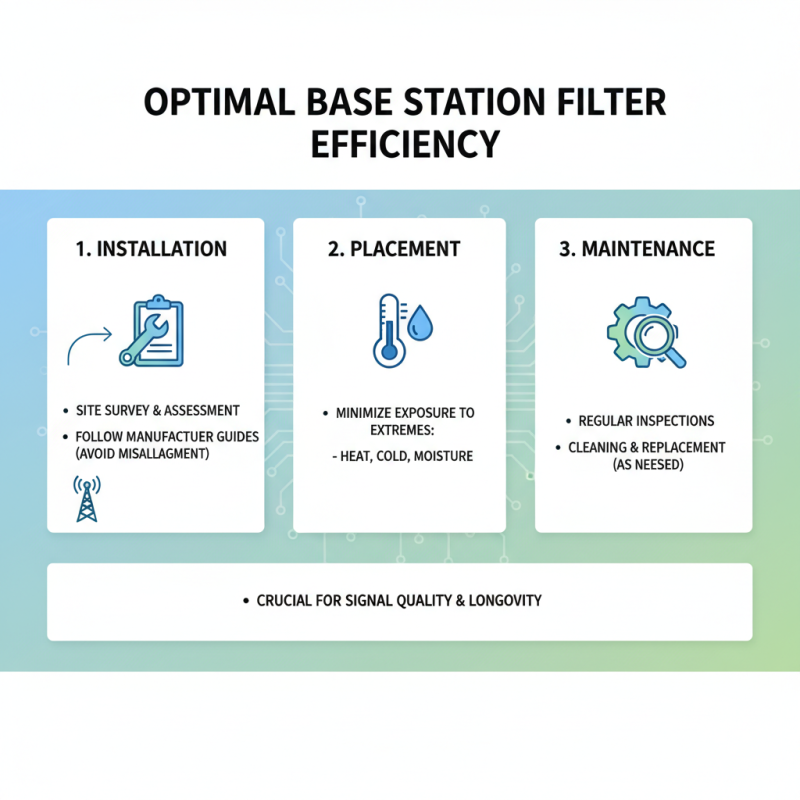
When it comes to ensuring optimal filter efficiency for base station filters, installation and maintenance are crucial steps that cannot be overlooked. The installation process begins with a thorough site survey to assess the location and environmental conditions. Proper installation involves following manufacturer guidelines meticulously to avoid misalignment, which can lead to degraded signal quality. It’s essential to mount the filters in a location that minimizes exposure to extremes of heat, cold, and moisture, as these factors can significantly impact performance over time.
Maintenance also plays a pivotal role in maintaining the efficiency of base station filters. Regular inspections should be scheduled to check for any signs of wear, corrosion, or physical damage that may compromise the filter's integrity. Cleaning should be performed periodically to eliminate dust and debris accumulation, which can hinder performance. Additionally, keeping track of the operational parameters and performance metrics will help in identifying any degradation early on, allowing for timely repairs or replacements to ensure uninterrupted signal quality and optimal performance.