Why Are Base Station Filters Essential for Enhancing Signal Quality?
In today’s fast-paced world, quality signal transmission is vital. Base Station Filters play a crucial role in this process. These filters enhance signal integrity, ensuring clear communication without interference.
Poor signal quality leads to dropped calls and slow data speeds. This can frustrate users and affect productivity. Base Station Filters mitigate these issues by eliminating unwanted frequencies. They safeguard the desired signals, allowing for seamless connections.
However, the importance of Base Station Filters is often overlooked. Many assume they are merely an accessory. In reality, these filters are foundational for modern communication. Embracing their significance can lead to better user experiences and improved network performance. Investing in quality filters makes a difference. The relationship between technology and user satisfaction depends on it.
Overview of Base Station Filters and Their Functionality
Base station filters play a crucial role in enhancing signal quality. These filters focus on specific frequency bands, allowing only the desired signals to pass through. By blocking out noise and interference, they help maintain a stable connection. This is vital in dense urban areas, where various signals compete for attention.
The functionality of base station filters is straightforward yet impactful. When signals enter a base station, filters analyze them. They separate useful communication signals from unwanted noise. The result is clearer calls, faster data speeds, and improved user experience. However, not all filters are created equal. Some may struggle with complex signal environments, leading to occasional disruptions.
The need for high-quality filters cannot be overstated. Poor filtering can cause dropped calls or slow internet. Users often report frustration when connectivity issues arise, highlighting the importance of reliable filters. Not every solution is perfect, and ongoing refinement is necessary. As technology evolves, so too must the design of these essential components.
Understanding Signal Quality in Telecommunications
In telecommunications, signal quality is crucial. High-quality signals ensure clear communication and reliable data transfer. Factors like interference and signal loss can degrade quality. Thus, maintaining optimal signal quality is essential for effective communication.
One effective method to enhance signal quality is using base station filters. These filters help reduce unwanted noise. By eliminating interference from other signals, they boost the clarity of the desired communication. This is especially important in busy urban areas, where multiple signals overlap.
Tip: Regularly inspect and maintain your base station filters. Dirty or damaged filters can compromise signal quality.
Another point to consider is the unique environment of each location. Urban environments have more obstacles that can impact signals. Filters designed for specific conditions can provide better performance. Always assess your situation before choosing a filtering solution.
Tip: Consult with professionals to find the right solutions for your environment. Customized approaches often yield the best results.
The Role of Base Station Filters in Interference Reduction
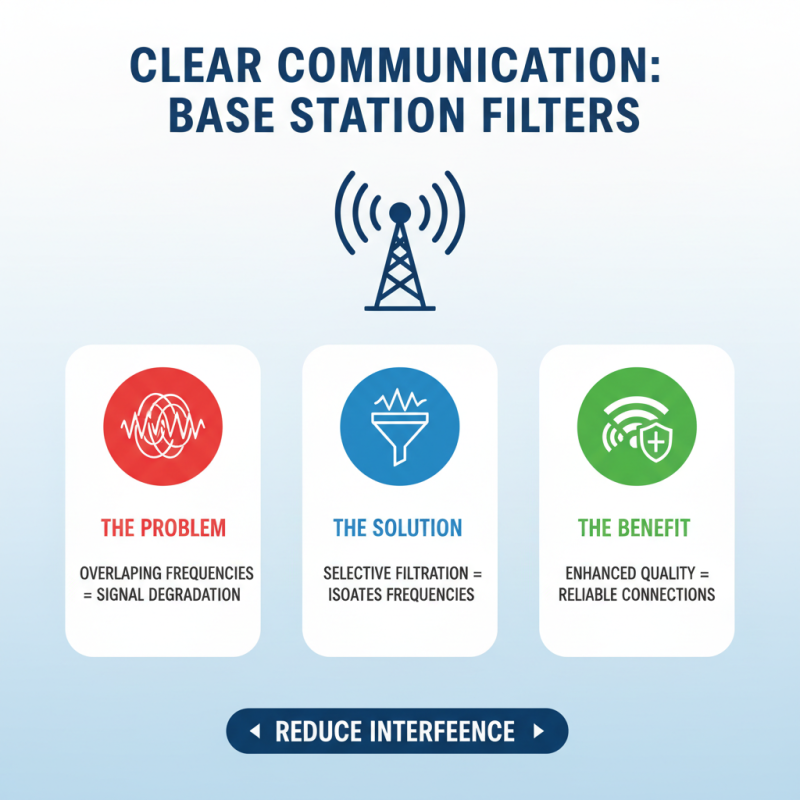
Base station filters play a critical role in enhancing signal quality by reducing interference. In a world filled with various signals, clear communication is vital. Without proper filtering, different frequencies can overlap, leading to signal degradation. Base station filters identify and isolate specific frequencies. They allow important data to pass through while blocking unwanted signals. This selective filtration helps maintain high-quality connections in crowded environments.
Using filters can significantly improve network performance. They reduce noise, allowing the signal to remain strong. This is especially important in urban areas where many devices operate simultaneously. When filters are not used, users may experience dropped calls or slow data speeds. These issues can frustrate customers and hinder business operations. It's crucial for service providers to invest in quality filtering technology.
Tip: Regularly check the performance of base station filters. Signs of interference or reduced quality may indicate a need for maintenance. Ensure that technicians are trained to address filter-related issues. They should know how to evaluate filter effectiveness and identify potential problems. Regular updates can keep the system running smoothly.
Types of Base Station Filters and Their Applications
Base station filters play a crucial role in improving signal quality. They prevent interference from unwanted frequencies. This helps maintain a clear communication line. Different types of filters serve various applications. Each type addresses specific challenges faced in telecommunications.
The bandpass filter allows signals within a certain frequency range to pass. This is ideal for mobile networks that need to separate channels.
Another important type is the notch filter. This filter blocks specific frequencies that cause interference, ensuring a cleaner signal.
Finally, low-pass filters are effective in eliminating high-frequency noise that can degrade service quality.
Understanding these filters is vital for network performance. Without them, signal degradation may occur frequently. Poor communication can frustrate users. However, some might overlook their importance, focusing solely on hardware strength. Including filters is an essential strategy in creating an effective communication infrastructure.
Impact of Base Station Filters on Network Performance and Efficiency
Base station filters play a crucial role in enhancing network performance and efficiency. These filters clean the signals transmitted and received at base stations. By reducing interference, they allow for clearer communication. When signals are less cluttered, users experience fewer dropped calls and better data speeds. This reliability is essential, especially in urban areas with dense networks.
The impact of base station filters extends beyond just individual user experience. They improve overall network capacity. With better signal quality, operators can serve more users simultaneously. However, the implementation of these filters is not without challenges. Engineers must balance filtering techniques with signal strength to avoid unwanted loss. Sometimes, finding that perfect balance can take numerous trials. It’s a continuous learning process where adjustments are necessary.
Moreover, as technology evolves, so do the requirements for filters. They must adapt to new frequency bands and modulation methods. This constant evolution presents an ongoing challenge for network operators. Regular assessments of filter performance are needed. An ideal filter today may not be optimal tomorrow. Companies must stay vigilant and proactive in seeking innovative solutions.
Impact of Base Station Filters on Network Performance