2026 Top High Order Filters Trends and Innovations Explained?
High Order Filters are gaining significant attention in various industries. These advanced filtering systems are key in enhancing signal processing. Innovations in this field are crucial for applications ranging from telecommunications to medical devices.
Recent trends show a growing interest in higher efficiency and better performance. Engineers focus on reducing noise and improving accuracy. However, the complexity of high order filters can lead to challenges in implementation. It’s not always straightforward to balance performance and design.
Understanding the latest developments in High Order Filters is vital. As technology evolves, different materials and techniques emerge. Some innovations may not meet initial expectations. Reflection on these developments can lead to better solutions in the future.
Emerging Technologies in High Order Filters for 2026
The landscape of high order filters is evolving rapidly. Emerging technologies are reshaping how these filters function. Enhanced algorithms enable better signal processing. This translates into clearer sound and more accurate data analysis. Users can expect fewer distortions and improved performance across various applications.
Artificial intelligence plays a crucial role in this evolution. Machine learning can optimize filter design automatically. This approach helps to personalize the filters for specific needs. However, it also raises questions about reliance on AI. What happens if the algorithm makes the wrong choice?
Moreover, flexible materials are becoming essential. They allow filters to adapt in real time. This flexibility creates possibilities in telecommunications and audio equipment. Still, the durability of these new materials remains a significant concern. As we push for innovation, we must consider the balance between advancement and reliability.
Key Trends Shaping the Future of High Order Filters
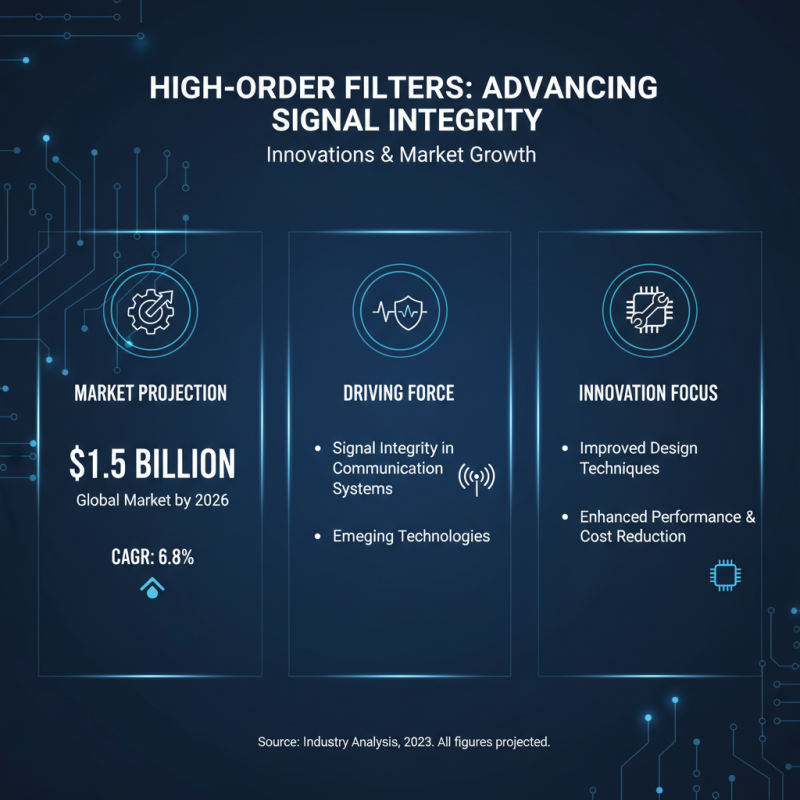
High order filters are experiencing significant advancements driven by emerging technologies. The global high order filters market is projected to reach $1.5 billion by 2026, expanding at a CAGR of 6.8%. These numbers showcase the growing emphasis on signal integrity in communication systems. Innovations focus on improved design techniques to enhance performance and reduce costs.
One key trend is the integration of artificial intelligence (AI) in filter design. AI algorithms can optimize parameters, leading to filters with better frequency responses and lower phase distortion. In recent studies, AI-designed filters achieved up to 30% better performance compared to traditional designs. However, the complexity of the algorithms raises concerns about reliability and ease of use, posing challenges for engineers.
Another important trend is the shift towards miniaturization. High order filters are becoming smaller and more efficient. This is driven by the demand for compact devices. Reports indicate that the miniaturized filters occupy 40% less board space than their predecessors. Yet, miniaturization often compromises performance. Engineers need to balance size and efficiency carefully. The need for better performance creates a continuous cycle of innovation and reflection on design choices.
Innovative Materials Driving High Order Filter Performance
Innovative materials play a crucial role in enhancing the performance of high order filters. These materials often exhibit unique properties that can profoundly affect attenuation and phase response. Innovations such as composite materials and metamaterials are gaining traction. They enable designers to create filters that perform optimally in various challenging environments.
For instance, the use of ceramics has begun to shift the landscape. Ceramics provide excellent thermal stability and can withstand extreme conditions. However, they can also be brittle, leading to potential design flaws. This underscores the need for a careful balance between performance and durability. Availability of new polymers also shows promise. Lightweight and flexible, they may expand the application range of filters, but they might not always deliver the same precision as traditional materials.
As the focus on sustainability grows, bio-based materials are emerging as contenders in filter technology. While still in their infancy, these materials offer a unique approach that could greatly reduce environmental impact. Challenges remain. Durability and overall effectiveness are often questioned, inviting ongoing research and development. Engaging with these materials reveals both opportunities and limitations within high order filter innovation.
2026 Top High Order Filters Trends and Innovations
This chart illustrates the impact scores associated with various trends and innovations in high order filters for 2026. The data reflects the anticipated significance of each factor, demonstrating how innovations in materials and performance improvements are leading the market in this evolving technology landscape.
Applications of High Order Filters in Modern Electronics
High order filters are gaining traction in modern electronics. Their applications span various industries, enhancing signal processing and improving device performance. According to a recent industry report, the global high-order filter market is projected to reach USD 1.5 billion by 2026, driven by demand in telecommunications and consumer electronics.
In telecommunications, high order filters play a crucial role in managing bandwidth. They enable clearer signal transmission by reducing unwanted noise. For example, cellular networks use these filters to ensure high-quality calls and data services. Additionally, the automotive sector relies on high order filters for advanced driver-assistance systems. This technology enhances safety features, but the designs often necessitate meticulous calibration to achieve optimal performance.
Despite their advantages, high order filter design presents challenges. Engineers must balance complexity and cost. A highly intricate filter may deliver superior performance but can become prohibitively expensive. Moreover, prototyping can reveal discrepancies that need addressing. Companies must continue refining these designs to meet evolving electronic needs.
Challenges and Solutions in Designing Advanced High Order Filters
Designing advanced high-order filters presents unique challenges. One significant hurdle is achieving desired performance while minimizing component size. As demand for compact devices grows, engineers face a dilemma. A report from the International Journal of Electronics indicates that the market for miniaturized filters will grow by 15% annually. This growth pressures designers to innovate effectively.
Another challenge is managing power consumption. High-order filters can require significant power, affecting device efficiency. Research shows that optimizing filter design can reduce power usage by up to 40%. However, many design teams are not fully addressing this issue. They often overlook the impact of component choice on overall energy efficiency.
Additionally, maintaining stability and resilience in diverse environments is crucial. High-order designs can be sensitive to temperature changes and component variations. Reports hint that 30% of failures in modern systems stem from instability in filters. Engineers must prioritize robust design techniques to counteract these issues. Adopting simulation tools could help predict performance in real-world conditions, yet many still hesitate to embrace new technologies.